Connect with us

Blockchain & AI

CAMBRIDGE ANALYTICA: FACEBOOK’S $5 BILLION FINE DOESN’T MAKE TRUMP & BREXIT GO AWAY

Opinion

CAMBRIDGE ANALYTICA: FACEBOOK’S $5 BILLION FINE DOESN’T MAKE TRUMP & BREXIT GO AWAY

Published

on


Yesterday the US Federal Trade Commission slammed Facebook with a $5 billion fine – but it fails to fix the catastrophic damage already done.


A record-breaking fine

The fine relates to numerous data security failings surrounding the Cambridge Analytica scandal, during which the personal information of millions of people was supplied by Facebook to the London-based political consulting firm, without consent.

Cambridge Analytica specialised in political campaigning and is thought to have decisively influenced both the US presidential election, where they managed Trump’s digital campaign, and the Brexit referendum, when they managed Vote Leave’s campaign.


Trump and Brexit

As revealed in the recent Netflix documentary ‘The Great Hack’, Cambridge Analytica went far beyond anything previously seen in terms of collecting data on users – at one point openly claiming to have 5,000 data points on every American voter.

Far from simply targeting broad interest groups, the firm used big data and AI to hone-in on what it called the ‘persuadables’ – the relatively small number of floating voters – during campaigning, and bombarded them with tailor made video, image-based and text-based content, playing on their personal triggers and fears, to get them to vote a certain way.

This was most obviously demonstrated in the 2016 presidential campaign by the outright despicable anti-Hilary content that ‘persuadables’, especially in so-called swing states, were literally bombarded with. In the Brexit campaign of 2016 it manifested in Cambridge Analytica saturating British ‘persuadables’ with content portraying the European refugee situation as far worse than it actually was, fabricating fake news about immigrant communities, and scapegoating entire nations and groups.

Despite indisputable evidence of Cambridge Analytica’s involvement in the Vote Leave Brexit campaign, the company was intransigent enough to flat out deny it for many months, despite a representative of the company being clearly visible on video at the press launch of the campaign, the campaign saying the had hired the company on its own official site, and numerous references in talks and media posts.


Facebook collusion

In is inescapable that Cambridge Analytica could only do what it did, because Facebook actively colluded with the company, allowing them to ‘scrape data’, including – at least according to former CA employees speaking on ‘The Great Hack’ – personal messages, and not only of those people who had unwittingly completed phishing ‘personality test quizzes’ and alike (apparently a tactic favoured by CA), but also those peoples’ contacts.

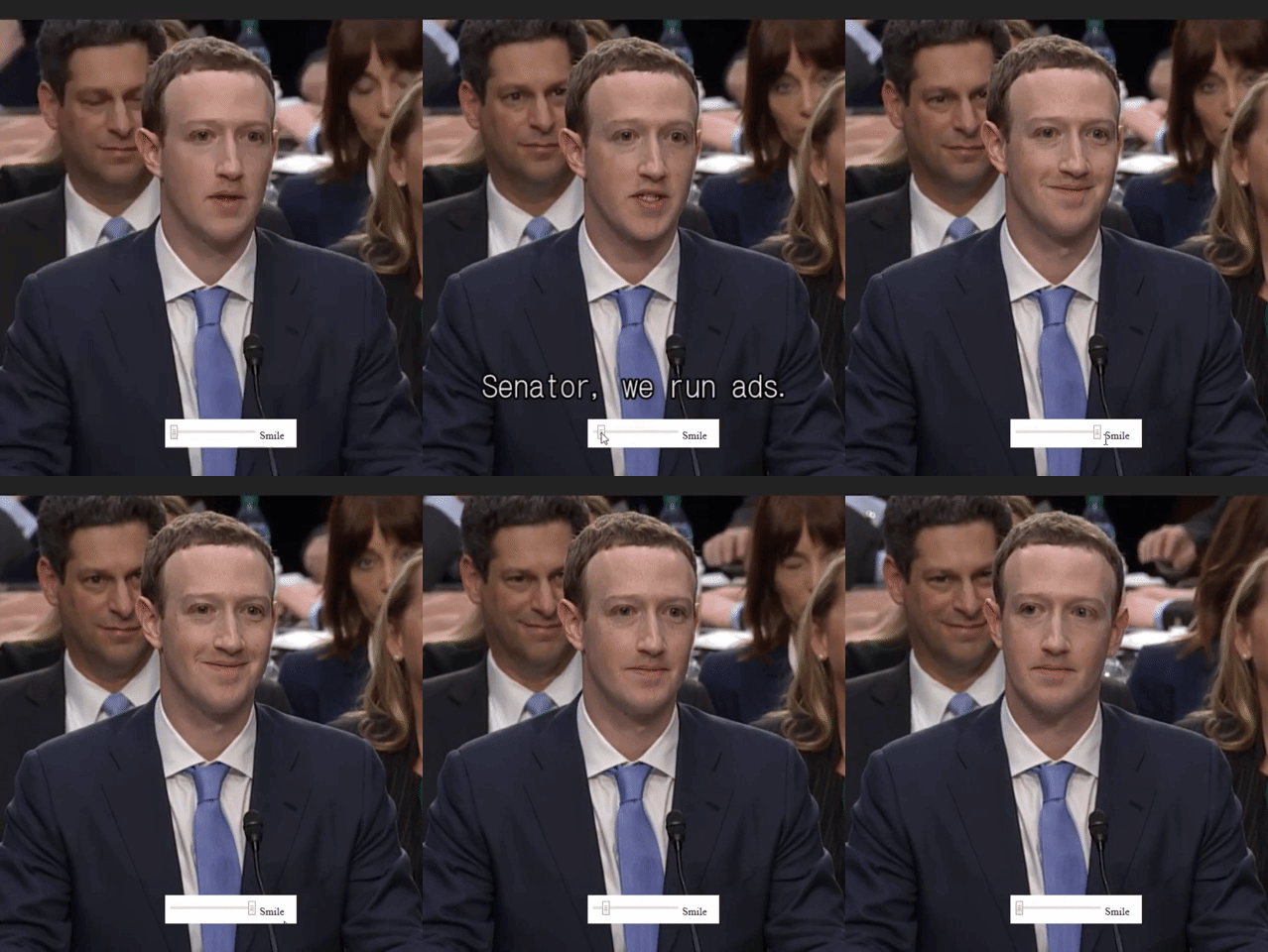
Witnesses have even alleged that Facebook representatives actively helped Cambridge Analytica, in-person, in campaign offices. Despite all of this, Mark Zuckerberg avoided giving straight answers to questions when called before committees in the US, UK and Europe, effectively denying knowledge of specific wrong-doing.


Cambridge Analytica, Bannon, Trump, Banks, Johnson, Farage and Russia

Things get even more sinister when you consider that one of the people sitting on the board of Cambridge Analytica was Steve Bannon – White House Chief Strategist during the first seven months of Trump’s presidency, and former executive chairman of the notoriously far right Breitbart News.

There are also well established connections to and between British millionaire businessman Aaron Banks, one of the main funders of the Vote Leave, and subject of a criminal investigation over the source of funds, Nigel Farage, former leader of the UK Independence Party, current leader of the Brexit Party, main architect of Brexit, and close friend of new British Prime Minister Boris Johnson and US President Trump.

And, to top it all off, there have been constant accusations regarding the possible involvement of the Russian government in financing the campaigns. Something that would make sense, since a Trump presidency and the UK leaving the EU would significantly weaken the European Union and NATO, clearing the way for Putin to make more moves in eastern Europe, from the Ukraine to the Baltic states.

And, all of this because of Facebook.

Too little, too late?

So, with the world hurtling towards World War 3 courtesy of Trump, and wannabe dictator Farage effectively in control of the UK (soon to be rump England, with the inevitable upcoming UDI’s of Scotland and Wales, and reunification of Ireland) through his imbesilic puppet Johnson, Zuckerberg’s apologies and $5 billion from Facebook isn’t really going to do anything to remedy the catastrophic global predicament we find ourselves in.

Of course, we all share part of the blame here. For years most of us were content to lap up the latest ‘free’ social media products and services, without going to the effort of reading the terms or thinking about the possible implications.

Sure, now we have GDPR, and there’s a raft of new rules Facebook will have to comply with, including implementing a new multi-layered privacy compliance system, and new tools to help the FTC maintain oversight of the social media giant, but the damage is already done.

As Cambridge Analytica whistleblower Christopher Wylie told a UK select committee, if an athlete is caught out in doping tests, they don’t say “ah well, they probably would have won the race anyway, and let them keep their medal.”


This article features opinion of the author only and does not necessarily reflect the views of Pentagon Digital Limited.


With several years experience in the igaming and sports betting industries in Malta under his belt, over the last few years Oliver has developed a passion for blockchain and an interest in esports. He’s also a published novelist and has a background in art and photography.


iGaming

REMOTE WORKING & DIGITAL SUMMITS – A CHAT WITH PIERRE LINDH, THE MAN BEHIND iGAMING NEXT

Published

on

How is the iGaming industry coping with coronavirus, and what does the future hold?

The iGaming industry has led the way in pivoting to a work-from-home business model during the COVID-19 crisis, but there is no doubt that the pandemic has had a massive impact on industry events.

With this is mind we thought it was the perfect time to get an insight from Pierre Lindh, Managing Director of Ambassador Events – organiser of one of the industry’s most anticipated summits, iGaming Next, Malta ’20.


Hi Pierre, thanks for joining us. First up, can you tell us how iGaming NEXT differs from other trade shows, and if you were inspired by other events?

Inspired by conferences like WebSummit, iGaming NEXT puts the content as our primary focus, which strangely you don’t see much at other large trade shows within our industry where the conference is generally pushed to the corner.

iGaming NEXT is a content driven conference focused on the future of iGaming and we discuss big ideas, we connect industry leaders and we bring the industry closer together to face the larger challenges and opportunities that face our industry. Our obsession with high level content and knowledge sharing is what makes us different.


With iGaming NEXT going digital due to the COVID-19 crisis, are you still planning to host a physical event later in the year too?

Great question! While we are keeping a close eye as the situation develops, we are still pushing ahead as planned with iGaming NEXT on the 29th and 30th of September with confidence. We are in close discussion with our partners and while we are confident that we will be able to go ahead, we are also preparing back-up solutions in case we would deem it unsafe to run the event. The partners have been very supportive which is great!


Do you think the shift to home working sparked by the COVID-19 crisis will last?

This is a hot potato within the HR-departments at the moment and through our iGaming HR Forum, HR Connect, we have been discussing this a lot lately. The consensus seems to be that no, generally people want to go back to their offices, but the anticipation is that employers will be much more lenient when it comes to letting their employees work from home.

Personally, I’m surprised actually of how much more productive I am right now. I can take meetings more efficiently via Zoom without having to account for travel time and so on. On the other hand, I miss being around my employees.


Expanding on that, there are clearly many benefits to working remotely, but do you think it inflicts a mental toll, given people are fundamentally social animals?

I think the combination of working remotely, the fact that society is closed and the anxiety some experience with what is happening overall is what puts some at risk. Certain risk groups such as expats who live by themselves who might not always have close social connections to lean on. HR’s have a huge responsibility right now to ensure that their staff is coping but even us as individuals have a responsibility to check up on our friends and loved ones from time to time.


So, all things considered, what is the most exciting trend in iGaming right now?

From an event organiser point of view who has been in the igaming industry for the last 15 or so years, I would say the digital events. The more we research them, the more we understand their power to connect the industry, generate business and share big ideas, which is what you want out of an event in the end of the day, so to be able to offer that in a much more cost efficient and resource efficient way is very exciting.

However, we should not underestimate the power of in person interaction, and those events will always have an important part to play, but I absolutely believe that there will be a space in the market for digital events even after this crisis subdues.


And, we have to ask, with new regulations and rules coming into force almost every day, do you think iGaming is being stifled by over-regulation, particularly in terms of advertising and marketing?

From an outsider’s point of view, it seems to me that the industry became too aggressive in their marketing, particularly in Scandinavia, which angered the population and turned the question political, and here we are.

Politicians are tightening restrictions on the industry as a political tool to win votes. With that in mind, the industry needs to cooperate much more to change the perception from an industry that only brings problems, to an industry that is fun for the customers. The good news is, that several industry organisations are working hard together with its members on these initiatives. This is no easy task of course but changing the tone of the marketing is important.


Finally, as we are both based in Malta, do you think the country can retain its status as Europe’s iGaming hub as the industry continues to evolve?

Yes, Malta will remain the hub of gaming for a long time to come. There is an unparalleled iGaming ecosystem in place in Malta from the many years of gaming operations here. Everything from robust political backing, rather than counter-action which you see in most other countries. Malta is English speaking which is a huge advantage as well.

The trend towards remote work will only make Malta’s spot as the hub of gaming in Europe stronger, as more people will be able to spend 50% of their time in Malta, and 50% in their home countries, which removes a hurdle for people who might not be comfortable to 100% commit to a permanent move from day 1.


Its certainly an interesting time to be in iGaming! So, if you want to find out more and join the debate, we recommend heading over to https://igamingnext.com/ and securing your online seat for the upcoming iGaming Next Online digital summit, taking place from 4-6 May 2020.

In the meantime, it’s a big ‘thank you’ to Pierre for sharing his thoughts on some fascinating issues.

See you at the digital summit!


All original content featured on this site is © Pentagon Digital Limited, 2020.

Continue Reading

Blockchain & AI

ENABLING DIGITAL GHETTOIZATION? TECH COMPANIES LOSE SIGHT OF BIG PICTURE IN RACE TO LIFT LOCKDOWNS

Published

on

With governments around the world clearly having no realistic exit strategies for the COVID-19 lockdowns, tech companies are piling in to make a bad situation worse.

After Malta-based Chiliz revealed it is developing a blockchain-based system to allow fans to “prove their immunity” and attend football matches again, Oracle has now partnered with Vottun to release a digital health passport, which it says will allow employees to go back to work.

The “Immunity Passport” developed by Vottun is said to record your immunity status on the blockchain, allowing it to be easily checked by authorities by scanning a QR code.

Spain, which has been one of the countries hardest-hit by COVID-19, is already rolling out the system in partnership with PwC, while Vottun has said is has been talking with authorities in the United States too.


AYO.NEWS says:

This madness needs to stop now. Tech companies are understandably enthusiastic about the technology, but there is far more at stake here, and it seems they are all missing the big picture.

As we have argued previously, this technology will absolutely create a two-tier segregated society in which only those ‘approved’ by authorities are allowed to re-join society. This is opening the door to digital ghettoization or apartheid.

No one can argue the COVID-19 (coronavirus) is not having a terrible impact, but it seems people are losing all perspective and rationality. The lockdowns have already ensured the biggest economic calamity since the Great Depression, and if they go on longer they are sure to lead to mass social issues in many places. This will all lead to FAR more deaths in the long-run, than the virus could have ever inflicted.

But, trying to fix this by creating some sort of 1984 or Gattaca-style dystopia is utter madness. What is the point in fighting this “war” against the virus, if the society we are left with has forsaken everything millions have fought, and died, defending across generations, including World War 2?

Of course, there are a myriad of other reasons why this system is madness too, including the fact tests are not reliable, there is growing evidence that being infected and recovering does not make you immune, the virus is rapidly mutating, and it will obviously cause people to TRY and get infected so they can resume their lives.

Lockdowns could have worked in small areas, if they had been implemented early enough. However, politicians in every country refused to see reality and procrastinated. Now they have implemented them, utterly destroying many millions of lives for the foreseeable future. Now, we have tech companies jumping on the bandwagon, claiming to offer a way out, but actually just opening the doors to an even worse nightmare.

I’m with John McAfee on this one.


AYO.NEWS says features the opinion of the author and does not necessarily reflect the views of Pentagon Digital Limited.
All original content featured on this site is © Pentagon Digital Limited, 2020.

Continue Reading

Blockchain & AI

WITH WORLD ON BRINK OF ECONOMIC COLLAPSE, BITCOIN’S ‘MOMENT OF TRUTH’ APPROACHES

Published

on

With the IMF now warning of the biggest economic crash for 90 years because of the COVID-19 crisis, Bitcoin (BTC) is facing its ‘moment of truth.’


Lockdowns triggering economic catastrophe

On 14 April the IMF published its quarterly World Economic Outlook report, saying the lockdowns due to COVID-19 (coronavirus) are ushering in the worst economic downturn for 90 years, and predicting a staggering USD $9 trillion of losses within a couple of years.

Meanwhile in the UK, the Office of Budget Responsibility (OBR) has issued an even scarier warning, saying the country faces the deepest recession for 300 years, with GDP expected to plunge by 35% and 2 million to lose their jobs.

As the true toll of economic damage becomes clear, many are now arguing the actions taken to combat the pandemic are certain to cause far more damage, including mass poverty and millions of deaths, than the virus would have done had it just been left to burn.


Bitcoin’s record correlation with traditional markets

With the world facing an unprecedented economic crisis, the COVID-19 pandemic still raging, and warnings of a possible second wave of infections, the world’s biggest cryptocurrency, Bitcoin (BTC), is now facing something of a moment of truth.

Prior to the crisis, Bitcoin had been assumed by many to be a ‘safe haven’ for investors – sitting in a separate digital world, less affected by real-world political and economic events. However, over the past few months, Bitcoin has reached a record correlation with traditional markets, including the S&P 500 and gold – with the sudden liquidity crisis in global markets appearing to drive confluence across asset classes.


Bitcoin Halving and moment of truth approaches

Now, with next month’s Bitcoin Halving rapidly approaching, we are about to see if the world’s foremost cryptocurrency will be able to achieve the much-anticipated post-halving bull trend.

Though the halving has long split crypto pundits, with some predicting it to be a non-event, and others convinced it will ignite the fuse to a long bull run, we perhaps shouldn’t read to much into Bitcoin’s current close correlation to stock markets and gold.

Back at the start of the 2008/09 Financial Crisis, the price of gold, the traditional safe haven asset, actually dropped 30% over the first six months, but then went on to gain more than 150% over the following three-and-a-half years.

It could be argued that the reason Bitcoin (BTC) hasn’t so far achieved it’s clear ‘safe haven’ potential, is because until this point most investors have simply failed to appreciate the sheer scale of the global economic crash that is now underway.

The unprecedented nature of the lockdowns, and psychological displacement caused – with many people feeling they are on simply on an unexpected holiday, rather than on the precipice of disaster – has obviously clouded judgement and wrong-footed many. But, as the insane scale of the collapse becomes apparent, it could well send investors fleeing to both gold and Bitcoin (BTC).

One thing is for sure. A couple of years from now, the global economy is going to look very different.


All original content featured on this site is © Pentagon Digital Limited, 2020.

Continue Reading

Opinion

WHY NIGERIA CONTINUES TO BE A FERTILE GROUND FOR SPORTS BETTING COMPANIES

mm

Published

on

The sports betting industry in Nigeria has been experiencing exponential growth in the last few years, with more and more betting companies populating the market, and more people taking to sports betting on a daily basis.

Nigeria has the second largest online gambling market in Africa, behind South Africa, with an estimated 60 million people between the ages of 18 and 40 involved in sports betting activities in the West African nation. The total betting expenditure stands at around a staggering $2 billion per year, and those figures are showing no signs of slowing down.

One thing is for sure, new customers will not be lacking for choice. According to MyBettingSites Nigeria, a website that reviews and ranks bookmakers in the country, there are over 50 betting companies currently operating in Nigeria. There is a good mix of local and international sites, with Bet9ja and NairaBET spearheading the local challenge, while Betway and 1xBet lead the foreign contingent.

The rapid increase in the number of betting sites in Nigeria has naturally led to an extremely competitive market, with bookmakers diversifying their portfolio to gain their share of the large pool of new customers.


Why has Nigeria become very viable for betting companies?

Nigeria provides a very fertile ground for betting companies, with most of these bookies generating millions of dollars in revenue every year. A recent report on international accounting firm, KPMG, showed that Bet9ja has an average monthly turnover of $10 million.

But what has made the Nigerian betting market so attractive and productive for these bookmakers?


Large population

Home to over 200 million people, Nigeria is the most populous country in Africa and the seventh most populous nation in the world. Betting companies are very reliant on numbers, and they get numbers in abundance in Nigeria.


Football-crazy country

Nigeria does not only have a massive population, but the people are also crazy about their sports, especially football. The country is arguably the biggest footballing nation in Africa, and the fans are amongst the most passionate in the world. Nigeria has one of the most followed national teams, and has produced some of the best players to have ever played the game.

Nigerians do not only follow the Super Eagles with gusto, they are also very knowledgeable and fanatical about European football. Top leagues like the English Premier League and the Spanish La Liga are hugely popular, with clubs like Manchester United, Arsenal and Barcelona enjoying huge fan bases in the country. It’s very easy to see why football betting is a huge sell in Nigeria.


Increase in availability of internet and mobile phones

The boom in sports betting in Nigeria has coincided with the sharp technological advancement in the country, with many Nigerians now owning smartphones and having easy access to the internet.

Gone are the days when Nigerians had to visit game houses, leaving with long betting slips in hand. Most of the people can now wager from the convenience of their phones. Betting companies have responded to this by designing more mobile friendly apps and enhancing their mobile features. The ease of sports betting and the entertainment it involves appeals greatly to Nigerians.


Convenient deposit methods

Another great reason for the surge in sports betting in Nigeria is the speed and convenience with which money can be deposited into betting sites online. Once you have a bank account and a bank card, which is very easy in Nigeria, you can easily fund your betting account through card deposits or online banking.


Get ready for more growth!

The betting industry in Nigeria will only continue to grow, so you can expect more companies to flood the country in the coming years, and the financial figures to keep hitting new heights.

Continue Reading

eSports

HOW COVID-19 HAS CHANGED ESPORTS BETTING FOREVER: ANALYSIS BY LOOT.BET

mm

Published

on


© Roman Kosolapov – Dreamstime.com

With entire industries collapsing before our eyes due to the ongoing global COVID-19 crisis, the digital space is holding up relatively well. However, even online businesses can expect to see some very real consequences sooner or later. Unfortunately, this will include the esports and esports betting industries. But, how exactly will the pandemic crisis hit the still maturing esports betting industry? Though we live in very unpredictable times, the LOOT.BET team has analysed the data available, and considered where things may go from here.


Audience

Despite all the disruption wrought by COVID-19, the esports industry has definitely lucked out in the fact that it can at least function, almost fully, in an online space that is unsusceptible to viruses (well, of the physical kind at least!). Of course, the part of the industry that can’t function is live events, and to this end esports operators have already lost a ton of money in terms of ticket and merchandise sales. Given this, we expect esports companies that rely on live events to suffer most from the pandemic, and some bankruptcies are likely.

However, esports in general won’t lose the ability to attract and engage fans, and will continue to see rapid audience growth. Illustrating this, key tournaments including ESL One Los Angeles and ESL Pro League 11 have migrated online and avoided cancellation. And, even if the COVID-19 situation worsens, we expect to see more major events shift online, but continue to operate.

One thing we can say with absolute certainty, is that the lockdowns being enforced in countries around the world, are actually boosting the growth of the esports audience. As people are stuck in lockdown, working remotely, or self-isolating, many are looking for new alternatives to their usual offline activities and entertainment. While existing esports fans are also finding they have a lot more time to indulge in their interest. Given this, we expect to see a large number of existing casual esports fans transform into fully-fledged esports enthusiasts.

Supporting these assertions are recent reports from Twitch showing a 20% increase in stream viewers over the first couple of weeks of the lockdowns. Of course, we should remain rational here, and not assume that everyone stuck at home will become an esports fan. Those who have never been interested in esports, or even video games in general, are more likely to spend their time watching Netflix or reading books. But, it is clear that the coronavirus-induced lockdowns will definitely stimulate the interest for esports among those casual viewers who, while already aware of esports, are yet to join what we would call the ‘active audience’.

So, what does this all mean for esports betting? Firstly, it means extra growth, with new spending by those who are stuck at home and bored. Secondly, it means a partial migration of active and professional bettors from traditional sports to esports, as they look for alternatives due to the global sports shutdown. Thirdly, it means increased activity from those already following and betting on esports.  


Activity

We can already backup our observations with hard figures. Just over the first couple of weeks of the lockdowns, the volume of bets placed at LOOT.BET has surged by an impressive 20% (and now, it’s growing by 20% every week), site traffic has grown by 30%, and registrations have rocketed by 50%. And, it should be added, these growth rates are in addition to the already accounted for organic growth, driven by ongoing marketing campaigns, and major events like ESL One Los Angeles, ESL Pro League 11, and LOOT.BET/CS Season 6.

It’s curious that self-isolation has affected not just our users’ activities, but their habits as well. For instance, as more people follow esports streams, the share of live bets is also growing at an accelerated pace. In 2019, live bets already accounted for a whopping 75%, but by March that had reached 83%. Besides this, more users are turning to previously less popular markets, such as the first Roshan kill in Dota 2 and winner of a pistol round in Counter-Strike: Global Offensive. It seems obvious this is down to the sudden growth of esports online, and the extra time people have to explore new markets thanks to lockdowns.

And, of course, being so hungry for classic sports, many sports fans and bettors have discovered an outlet in esports and virtual sports. Reflecting this, after extending our offers for FIFA 20 this March, we immediately saw a huge increase in terms of this discipline. In fact, despite being one of the less popular games at LOOT.BET prior to the coronavirus crisis, today FIFA 20 is generating greater bet volumes than Overwatch, Call of Duty and StarCraft 2 combined. In response to this, we’re also planning to develop our lines on NBA 2K, which was another previously unpopular discipline.


Betting

Even prior to the first case of COVID-19 being reported, some betting industry professionals were predicting that within 10-20 years, esports would catch up with all classic sports in terms of bet volume. However long the pandemic lasts, it now seems certain esports betting will catch up with traditional sports betting even sooner.

Indeed, over the past few years, esports has become one of the major disciplines for many classic sportsbooks – often eclipsing popular sports like basketball and baseball. But, in the current situation, esports and virtual sports are pretty much the only things both punters and bookmakers can bet on. The reality is that today, when even big betting operators are suspending activities and land-based casinos are completely shut, esports is acting as a critical lifebuoy for the gambling industry.

In this situation, the already intense war for esports bettors is sure to escalate even further. But, despite the massive resource advantage classic bookmakers had before the pandemic crisis, specialist platforms like LOOT.BET are still a long way ahead of the generic bookies. It is precisely because specialist esports betting sites are more in tune with the esports audience, better understand fans’ expectations and wants, and tend to respond more quickly to requests, that they are not suffering operating losses despite the serious COVID-19 crisis.  

Of course, after the pandemic is over classic sports, and our lives in general, will quickly return to normal. The unforeseen dynamics that have boosted esports betting will fade out, some of those new esports viewers will never become enthusiasts, and many sports punters will return to their traditional sports. But, the dramatic surge of interest in esports betting will have given a considerable impetus to the industry in the short term, and will have a very real lasting effect in terms of accelerating what was already phenomenal longer term growth.


Want to find out more about esports betting trends? Check out ‘A Portrait of the Typical Esports Bettor’ here

Continue Reading

iGaming

SPAIN, GIBRALTAR & MALTA: iGAMING MORE ECONOMICALLY IMPORTANT THAN EVER

Published

on

In COVID-19 hit Europe, iGaming is one of the few industries still going strong, with companies in hubs like Spain and Malta remaining optimistic.


iGaming powers ahead in Spain

With lockdowns leaving players with much more time on their hands, and companies easily able to switch to work-from-home operations, the iGaming industry, like esports, is still growing despite the crisis.

Cadiz and Ibiza, along with the British Overseas Territory of Gibraltar, are already home to many iGaming companies and employees, but in the now certain post-coronavirus economic crisis, the sector will likely become even more important to the local and national economy.

And, with the country set to see record unemployment among a large and tech-savvy young workforce, plus a property crash, businesses may well see costs fall considerably in the coming months and years.


Cadiz, Spain


Malta more dependent than ever on iGaming

Leaving the Iberian Peninsula, and heading east across the sea, another Mediterranean economy is also set to become much more dependent on iGaming due to COVID-19.

Malta, widely known as the iGaming hub of Europe has seen the other main plank of its economy, the tourist sector, utterly destroyed as flights and international travel have been halted. Even if lockdowns are eased in some countries over the coming weeks, the threat of a second wave of COVID-19 is likely to see mass travel restricted for many months or even years.

Of course, for Malta this also presents additional challenges. Already, before the COVID-19 crisis, iGaming employers were finding it increasingly difficult to recruit and retain the needed talent, due to the limited local talent availability and rising living costs.

With international travel likely to remain very difficult for a long time, the threat of further outbreaks, and the Maltese government’s unwise anti-immigrant stance during the crisis, any expansion for Malta-based companies dependent on recruiting foreigners may prove difficult.


Malta


Could regulators spoil the party?

Though online casino, virtual sports, and esports betting have been doing very well during the crisis so far, in some countries regulators could spoil the party.

As we reported last week, in Sweden-licensed operators have been threated with “extraordinary measures” unless the reduce the amount of online gambling, while Belgium has introduced strict weekly staking limits, and regulators in the UK, Malta, and the Netherlands have warned operators they are being watched closely.

If the crisis drags on, there is every chance we could see more jurisdictions implement limits, or even total bans – which would clearly spell disaster for one of the few industries still thriving.

Everything depends on the length of the crisis…


All original content featured on this site is © Pentagon Digital Limited, 2020.

Continue Reading

Trending


Click to comment

Leave a Reply

Your email address will not be published. Required fields are marked *