Connect with us

Blockchain & AI

COULD BITCOIN HIT $75K WITHIN WEEKS? “ALMOST PERFECT” CORRELATION WITH 2013

Blockchain & AI

COULD BITCOIN HIT $75K WITHIN WEEKS? “ALMOST PERFECT” CORRELATION WITH 2013

Published

on


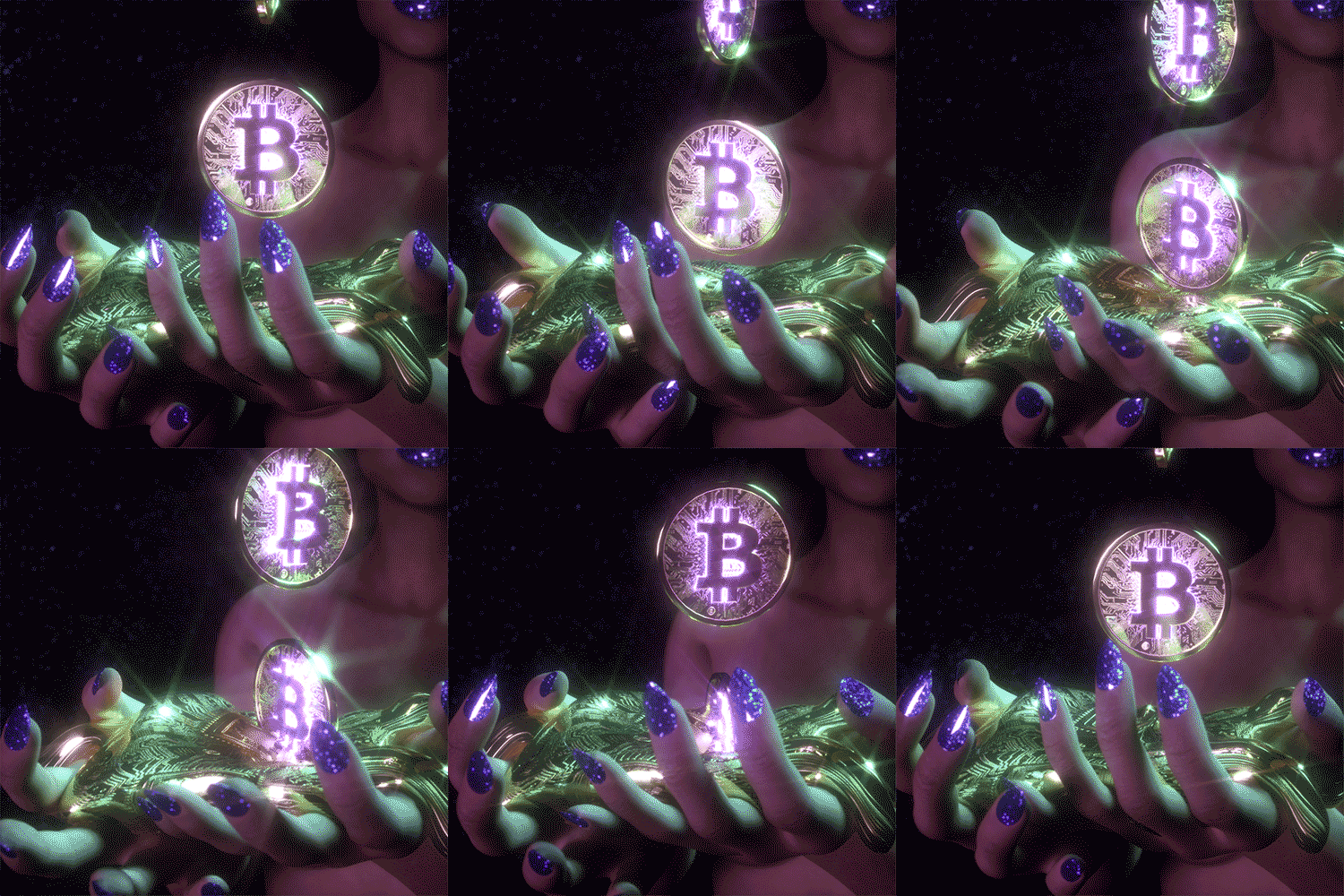
Could Bitcoin (BTC) hit USD $75,000 within weeks? As impossible as it sounds, one analyst says it could happen. 

According to Cane Island Alternative Advisors’ Timothy Peterson, BTC is now displaying an “almost perfect” correlation with 2013, when Bitcoin embarked on a 700% bull run, which if repeated from today’s price would give an incredible $75,000 within weeks.

Peterson claims Bitcoin’s recovery from its mid-March lows of $3,600 has tracked 2013’s price action almost perfectly. 


Despite the world of crypto being very different now than in 2013, when there was basically just one major exchange, the now defunct Mt. Gox, many notable figures have been making dramatic Bitcoin price predictions over the past few months. 

Last week we reported Blockstream Co-founder and CEO Adam Black had become the latest crypto heavyweight to predict BTC is set for a major bull run, while the previous week popular social media trader, investor and entrepreneur Credible Crypto had claimed the last 896 days were “simply one massive re-accumulation phase before the run to 100K+ bitcoin”. 

Notably, Greyscale’s Bitcoin Trust is also engaging in an unprecedented Bitcoin buying spree, scooping it up faster than it can be mined, and Robert Kiyosaki, author of New York Times bestseller Rich Dad Poor Dad, has advised people to buy Bitcoin to save themselves from a coming economic crash. 

On the flip slide, many analysts are convinced Bitcoin will stay muted, unable to maintain even a breakout from the $10K barrier. Indeed, last week Ethereum co-founder Vitalik Buterin took to Twitter to diss Bitcoin and urge the crypto community to move on, and even outspoken crypto advocate John McAfee has backtracked on his prediction of $1m Bitcoin, claiming it was just a joke.   


AYO.NEWS says:

$75K Bitcoin within weeks sounds insane, but then again, global lockdowns and quarantines would have sounded insane in January, and some of the scenes we’re seeing from the United States right now are straight from a dystopian science fiction movie, so who the hell knows anymore? Crazy times. 
 

‘AYO.NEWS says’ features the opinion of the author and does not necessarily reflect the views of Pentagon Digital Limited or its affiliates or associates. 
All original content featured on this site is © Pentagon Digital Limited, 2020

With several years experience in the igaming and sports betting industries in Malta under his belt, over the last few years Oliver has developed a passion for blockchain and an interest in esports. He’s also a published novelist and has a background in art and photography.


Blockchain & AI

MALAYSIAN SECURITIES COMMISSION SAYS BINANCE OPERATING WITHOUT AUTHORISATION

Published

on

Major cryptocurrency exchange Binance has made it to Malaysia’s naughty list, for operating in the country without authorisation.


Operating without authorisation

The Securities Commission Malaysia (SC) has added the cryptocurrency exchange to its list of unauthorised entities. Under Malaysian law, to operate in the country cryptocurrency exchanges must register as Digital Assets Exchanges with the SC. 

Applicants are given nine months, from the initial filing, to meet the SC’s regulatory requirements. However, thus far only three exchanges – Luno, Sinegy, and Tokenize – have been fully approved. As we previously reported, in June 2020, the Global Stock Exchange (GSX) Group has submitted an application for a license to launch a bespoke digital securities exchange in the country, which has been conditionally approved. 

In March this year, Binance announced it intended to use Malaysia as the Southeast Asian testbed for its crypto debit card. At press time (17 July 2020), Binance was still supporting the Malaysian Ringgit. 

Last month Binance was also scolded by the Brazilian securities watchdog, which prohibited the platform from offering Bitcoin (BTC) futures contracts in the country.


Where exactly is Binance based and regulated?

Though many have assumed Binance is based in Malta, in February 2020, the Malta Financial Services Authority (MFSA) put out a statement saying it had not authorised Binance to operate in the cryptocurrency sphere, and therefore the company was not subject to its oversight. 

However, people can be forgiven for thinking the exchange is based in Malta given the frequent coverage in Maltese press that refers to the business as “Malta-based”, the fact that the company signed a memorandum of understanding with the Malta Stock Exchange, regarding the launch of a new security token digital exchange, in September 2018. And, then of course, there’s the fact that Binance CEO Changpeng Zhao has previously said he was invited to Malta by the government to look at an upcoming crypto bill.  

Heck, even the Wikipedia entry for Binance lists it as Malta-based.

Indeed, reports suggest the company is actually registered in the Cayman Islands and the Seychelles. In June, data from blockchain analysis company Crystal, which classed Binance as a Seychelles-based, showed the country handled more BTC than any other country during 2019.


AYO.NEWS says:

In Binance’s defence, with the global regulatory patchwork that now exists, it must be almost impossible to stay technically legitimate in all jurisdictions. And, the fact that so far only three crypto exchanges have managed to get approval from the Malaysian Securities Commission would suggest the process itself may be experiencing problems or delays. We’re sure they will get things ironed out before long.

Regarding where Binance is based, CEO Changpeng Zhao (CZ) has made it very clear that he doesn’t believe in centralised working, or “fixed offices”, and the company obviously has workers and operations scattered all over the world. 

As for the Malta connection, we’d hazard a guess that the Maltese media, encouraged by local politicians, has just been so enthusiastic about their perceived success as ‘Blockchain Island’ that they latched onto Biance’s interest in the jurisdiction and ran with it. 

Staying with Binance, earlier this week the company announced the European launch of its Swipe-powered crypto debit card. 


‘AYO.NEWS says’ features the opinion of the author and does not necessarily reflect the views of Pentagon Digital Limited or its affiliates or associates. 
All original content featured on this site is © Pentagon Digital Limited, 2020

Continue Reading

Blockchain & AI

WARP SPEED TOWARDS BLOCKCHAIN AS ATARI CEO JOINS WAX ADVISORY BOARD

Published

on


Missile Command: Recharged (Image credit: Atari)

Atari is partnering with Worldwide Asset Exchange (WAX) to bring its video games onto the blockchain as Non-Fungible Tokens (NFTs). 

The announcement comes just two months before the planned Atari token public offering, and follows the news that Atari CEO Frederic Chesnais has joined the WAX Advisory Board, alongside major companies and celebrities including Google, Microsoft, Marvel Games, Magic Leap, and the real Captain James T. Kirk a.k.a William Shatner. 

Though Atari is still best-known for its 70s and 80s video games like Pong, Space Invaders, Tetris, and Pac Man, the company’s vision is anything but retro. Over the last year Atari has been making serious efforts to embrace blockchain technology, exemplified by the Atari Token.


Enthusiasm for Atari Token

In June both esports betting platform Unikrn and revolutionary MMORPG and online casino operator Native Gaming confirmed they would be integrating the Atari Token. While in April, the company announced a partnership with global monetisation platform and multichain blockchain API and wallet provider Arkane Network

Additionally, the company has created an Atari-themed virtual theme park in blockchain-powered virtual world, The Sandbox (TSB). TSB, which counts Animoca Brands as a major shareholder, has now attracted significant backing from investors including Square Enix, B Cryptos, Mindfulness Capital, and True Global Ventures. Notably, Animoca Brands has reported record revenues during the COVID-19 lockdowns. 


AYO.NEWS says:


Though many legacy firms know they should be exploring blockchain technology and tokenisation, few are doing so with the enthusiasm and rigour of Atari, and we’re sure it will pay off, introducing a whole new generation to a brand that many had all but written off. 


‘AYO.NEWS says’ features the opinion of the author and does not necessarily reflect the views of Pentagon Digital Limited or its affiliates or associates. 
All original content featured on this site is © Pentagon Digital Limited, 2020

Continue Reading

Blockchain & AI

MALWARE OPERATORS TARGET CRYPTO TRADERS USING MAC APPS

Published

on


Image credit: Wesson Wang

Investigators at cybersecurity firm ESET have found GMERA malware targeting crypto traders using applications on Apple’s macOS. 

According to Slovakia-based ESET, the malware has been integrated into sophisticated convincing-looking trading applications that provide full functionality but also steal users’ crypto funds. 

Those behind the malware have integrated it into a fake copy of the popular cryptocurrency trading application Kattana, and have also produced slick copies of the company’s website – copies easily good enough to fool those new to Kattana. 

Currently the crooks are also believed to be promoting four malware loaded copycat trading apps; Cointrazer, Cupatrade, Licatrade, and Trezarus. The fraudulent websites contain links to download ZIP archives which contain trojanised versions of the apps. 


Stealing user names, crypto wallets and screen captures

ESET says it has tested samples from Licatrade, which though slightly different to the other apps, functions in much the same way, with the trojan installing a shell script in the victim’s machine, giving the hackers access to their system. 

The crooks can then create command-and-control servers (C&C or C2), over HTTP between their own system and the victim’s. They can then steal information including user names, crypto wallets, location, and screen captures. 

ESET reported their finding to Apple, which quickly revoked the certificate issues to Licatrade. Two certificates used by other malware loaded trading apps have also been revoked. 

GMERA malware was first discovered by cybersecurity firm Trend Micro in September 2019 – in an app imitating Mac-specific stock investment app Stockfolio. 

According to ESET, the email address that registered the licatrade.com domain was the same as that which registered repbaerray.pw and macstockfolio.com – both of which were associated with the GMERA-laden Stockfolio app clone. 


Promoted by social engineering?

Interestingly, researchers say they still aren’t sure exactly how someone specifically becomes a victim of this hacking group in the first place, but suspect the dodgy operators directly contact their targets and “socially engineer” them into installing the malicious applications. 

They also noted that the mitigation implementation in the most recent version of macOS, Catalina, has worked to limit the success of the hackers because it requires the user of the machine to give permission for a screen capture to be taken – thus alerting them to the fact the malware is installed. 


AYO.NEWS says:

There are still a fair few annoyingly smug Mac users who believe the myth that they are safe from viruses and malware, so they should sit up and take note, especially if they are using their machines to trade crypto. 

But anyone trading crypto, on any machine or operating system, should always follow a few simple rules; always double check you are on the legitimate site and not a clone, and be extremely careful interacting with anyone who approaches you on social media regarding crypto trading opportunities. 

‘AYO.NEWS says’ features the opinion of the author and does not necessarily reflect the views of Pentagon Digital Limited or its affiliates or associates. 
All original content featured on this site is © Pentagon Digital Limited, 2020

Continue Reading

Blockchain & AI

BLOCKCRUSHR SUES CONSENSYS OVER ALLEGED IP THEFT DURING INCUBATOR

Published

on


Image credit: Markus Spiske

Canadian blockchain startup BlockCrushr is suing ConsenSys, accusing it of stealing proprietary technology. 

BlockCrushr was a participant in ConsenSys’ Tachyon accelerator program, and received a $100,000 investment from ConsenSys to back the launch of its Ether (ETH)-based recurring payments platform. The company’s founders, Andew Redden and Scott Burke, even relocated to California in September 2018 to take part in the incubator. 

Involvement in the program saw BlockCrushr provide ConsenSys with access to “every aspect of its marketing, financial, technical and regulatory strategy” along with the source code and proprietary technical solution for the payment platform. 

However, according to Halifax-based BlockCrushr, in early March 2019, ConsenSys suddenly ceased all communications with the company, and failed to deliver previously promised additional funding. Though the company did manage to find new investors, it nevertheless had to lay off several staff. 

Apparently, BlockCrush still attempted to make contact with ConsenSys to revive their relationship, and informed them of the planned launch date for the payments platform. Then, one day before that launch date, ConsenSys launched its own Ether (ETH)-based payments platform called ‘Daisy Payments.”

BlockCrushr’s is now accusing ConsenSys of masquerading as an advocate and mentor in order to replicate its proprietary tech. The lawsuit, filed in New York, is seeking a permanent injunction against ConsenSys, along with damages, legal expenses, and the disgorgement of profits derived from the allegedly stolen technology. 


All original content featured on this site is © Pentagon Digital Limited, 2020

Continue Reading

Blockchain & AI

TWITTER SUFFERS UNPRECEDENTED SECURITY BREACH, AS BITCOIN SCAMMERS HIJACK HIGH-PROFILE ACCOUNTS

Published

on


Image credit: Nahel Abdul Hadi

Twitter has suffered a major security breach, with crooks hijacking the accounts of tech moguls, celebrities, politicians, and major companies.


Unprecedented attack

The unprecedented attack saw hackers take control of accounts including Amazon boss Jeff Bezos, SpaceX and Tesla founder Elon Musk, and Microsoft co-founder Bill Gates. The accounts of political figures including former US president Barack Obama, and Democratic presidential candidate Joe Biden. 

On the celebrity front, accounts hacked included those of reality TV star Kim Kardashian, and rapper Kanye West, while the corporate accounts of ride hailing giant Uber and tech superpower Apple were also compromised. 


Another Bitcoin scam

With hackers in control of the verified accounts, an apparent Bitcoin (BTC) scam was launched. It saw Bezos, Gates, and Musk etc. pledge to send $2,000 for every $1,000 sent to a given Bitcoin address. 

According to Reuters, the criminals managed to fleece people out of around $100,000 worth of BTC before the scam was halted. 


Twitter’s response

Twitter initially said it was investigating a “security incident impacting accounts” at around midnight CET, and by the early hours of this morning had confirmed it had detected what it believed to be a “coordinated social engineering attack” by people targeting Twitter employees with access to the platform’s internal systems and tools. 

One the scale of the attack became apparent, Twitter locked down all the affected accounts and removed the illegitimate posts. Additionally, functionality was limited for a larger group of accounts, apparently including all verified accounts. 

Twitter has said it is restoring access to affected accounts only when it is certain it can do so securely. 


YouTube saw similar Bitcoin scam in June

In June YouTube saw a similar attack, with scammers hacking genuine YouTube accounts and adding branding to make them look like Elon Musk’s official SpaceX channel. 

Archived footage of Musk was then added to put on fake ‘live events’ in which people were told they could scan a QR code to pay Bitcoin (BTC) and join the conversation. 

It is thought at least 80K people watched the fake live streams, and 15.31 BTC was handed over by unsuspecting victims.  


AYO.NEWS says:

Though the scale and audacity of this attack is shocking in terms of the number and type of accounts successfully hacked, it netted comparatively little in the way of Bitcoin, which begs the question; was this just a distraction from something more insidious? After all, the fact that the hackers successfully gained access to Twitter’s backend, suggests they could have stolen a lot of data. 


‘AYO.NEWS says’ features the opinion of the author and does not necessarily reflect the views of Pentagon Digital Limited or its affiliates or associates. 
All original content featured on this site is © Pentagon Digital Limited, 2020

Continue Reading

Blockchain & AI

CLOUDCOIN: THE “UNHACKABLE” BLOCKCHAIN-FREE EMAIL-TO-EMAIL DIGITAL CURRENCY

Published

on


Image credit: CloudCoin

Could a digital currency function without blockchain technology? The developers of CloudCoin say ‘yes.’


DNS tech-based digital currency

CloudCoin has announced the launch of a cloud-based digital currency, with no blockchain, public ledger, accounts, or encryption. Instead the currency uses internet Domain Name Service (DNS)-derived technology to enable secure email-to-email, or email-to-wallet transactions. 

According to CloudCoin, it’s the most private digital currency ever developed, and eliminates the risk of theft because there are no private keys. They even say lost CloudCoins can be recovered. 

Introducing the new currency, President of the CloudCoin Consortium, Sean Worthington, said:

“Cryptocurrencies built on blockchains come with a host of challenges, making it difficult to do simple things like buy a cup of coffee. Transactions take too long, fees are too high and it is still too difficult to scale. We developed CloudCoin to overcome these challenges and pave the way for mass adoption.”


Efficient, and “quantum-secure”

CloudCoin’s cloud-based Redundant Array of Independent Detection Agents (RAIDA), is based on DNS technology and distributed across twenty-five national jurisdictions. Its transactions require such a small amount of energy that gas fees aren’t needed.

Furthermore, CloudCoin says it’s unhackable, can’t be double-spent, and not even governments have the ability to spy on it. This is because the RAIDA system only authenticates transactions, and all the information about the coins is held in the actual coins themselves – with each CloudCoin basically being a JPEG image file.

The CloudCoin White Paper gives a simple explanation of how it works as follows:

“I have a JPEG image with twenty-five random GUIDs (Globally Unique Identifiers) embedded in it that only I know. We call this JPEG a CloudCoin. Each RAIDA cloud knows one of the twenty-five GUIDs. I can prove to you that I am the owner by authenticating the GUIDs in parallel with the RAIDA using simple free open-source software made by the Consortium.

If I want to buy something from you, I will give you the JPEG image and now we both know the secret numbers. Anyone who knows the secret numbers can change them by contacting the RAIDA. Now you can use the secret numbers to change them to your own secret numbers. Now, you are the owner of the CloudCoin, and I no longer know the numbers registered in the RAIDA.”


Because authentication data is shredded instead of encrypted, and distributed across the RAIDA, the system is said to be “quantum-secure.” Speed isn’t going to be an issue either, with CloudCoin claiming 100,000 CloudCoins can be transacted, totally securely, in less than 3.5 seconds. 

CloudCoins can be transferred using ProtonMail, a free encrypted email service, or using a Sky Wallet. 


Available only in set denominations

Interestingly, because each CloudCoin is a file, they can’t be subdivided in the same way a crypto like Bitcoin (BTC) can be. Instead, just like real physical cash, they are issued in denominations of one, five, 25, 100, and 250 CloudCoins. But, unlike real cash, CloudCoin isn’t inflationary, with a set limit of 16,777,216 CloudCoins in the cloud. 

CloudCoin has even patented its “Method of Authenticating and Exchanging Virtual Currencies” in an attempt to stop copycats. 


Inspired by Stefan Molyneux?

According to its official website, the United States-based CloudCoin Consortium was created in October 2016, by founding member Sean Worthington. Apparently, he realised “monetary systems are physical implementations of information systems and money is data”, while sitting in the bath listening to Canadian YouTuber Stefan Molyneux. 

As many of you will know, Stefan Molyneux is nothing if not a controversial figure, having recently been banned from YouTube for “white supremacist content and hate speech.”


AYO.NEWS says:

While the CloudCoin system is very novel and interesting, I can’t help but notice what seems like a major flaw.

Sean Worthington points out that the complexity of blockchain-based cryptocurrencies makes it “difficult to do a simple thing like buy a cup of coffee.” But, while there may be some truth in this, if there are only ever going to be just under 17 million CloudCoins, and you can’t subdivide it beyond 1 unit, it’s clearly not scalable for everyday “simple” uses like buying a cup of coffee – because pretty quickly that cup of coffee would get very expensive!

But, we have to give the CloudCoin developers some serious kudos for “sticking it to the man” – even the graphic for a “One CloudCoin” bill features the famous image of the so-called ‘Tank Man’ of Tiananmen Square.

And, as for the part Stefan Molyneux played in inspiring the project – well, while it may seem tempting to run from anything even partly inspired by an alleged creator of “white supremacist hate speech”, can we really take anything at face value when it comes to YouTube censorship in the era of the “woke” witch-hunts and “cancel culture?”

I’ll keep an open-mind on this one, for now… 


‘AYO.NEWS says’ features the opinion of the author and does not necessarily reflect the views of Pentagon Digital Limited or its affiliates or associates. 
All original content featured on this site is © Pentagon Digital Limited, 2020

Continue Reading

Trending


Click to comment

Leave a Reply

Your email address will not be published. Required fields are marked *